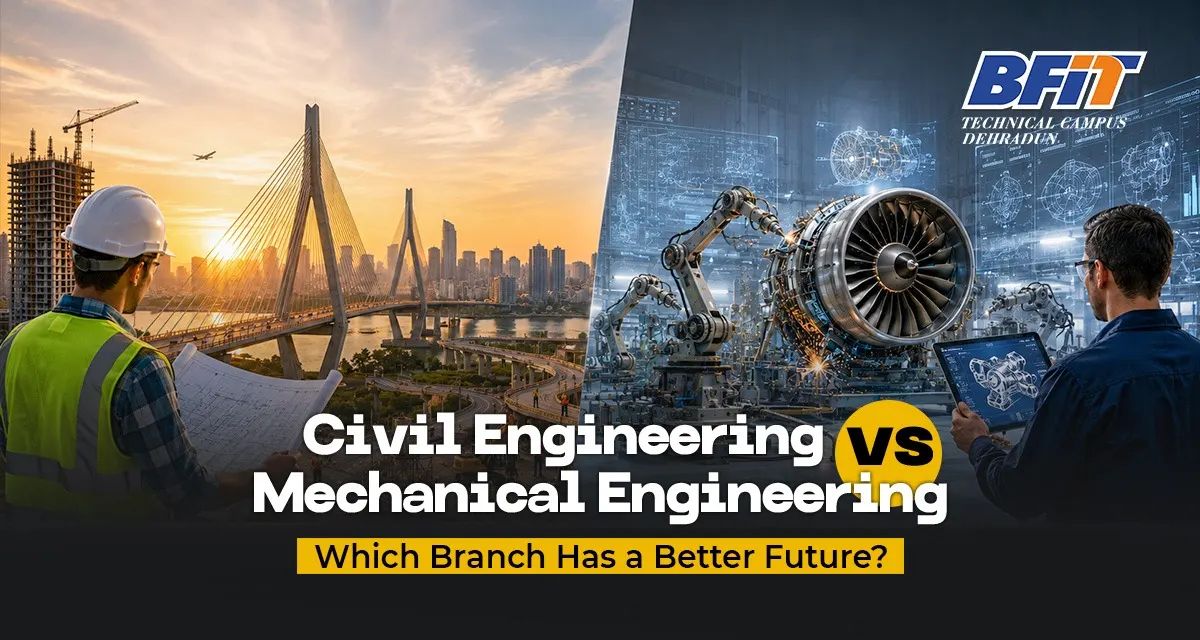
If you’ve just finished 12th and find yourself stuck between civil and mechanical engineering, you’re definitely not alone. Almost every science student goes through this exact dilemma at some point. Both branches have been around for decades, both have solid job markets and both keep showing up on every “top engineering courses” list out there.
So the real question isn’t which one is “better” — it’s which one fits where you actually see yourself in the next ten years.
That’s why this comparison of civil engineering vs mechanical engineering looks at what each branch involves day to day, where the jobs actually are and how to think through the decision instead of just guessing your way into one.
Civil engineers build the physical world around us — roads, bridges, buildings, dams, water supply systems and pretty much anything that needs to stand up and stay standing for decades. The work ranges from designing a structure on paper to supervising it being built on site, brick by brick. If you like seeing your work turn into something physical and tangible, this branch tends to feel rewarding in a very direct way.
Common career paths for civil engineering graduates include:
• Site engineer or supervisor on construction projects
With India’s continued push toward smart cities, highways and metro expansion, this field shows no real signs of slowing down.
Mechanical engineering is broader in scope. It deals with machines, engines, manufacturing processes, thermal systems and basically anything that moves or generates power. It’s often called the “evergreen” branch because its core principles apply across almost every industry, from automobiles to aerospace to factory floors.
Common career paths for mechanical engineering graduates include:
As the auto sector shifts toward electric vehicles and factories lean further into automation, new opportunities keep opening up in areas that barely existed a decade ago.
In the debate of civil engineering vs mechanical engineering, people are usually trying to figure out which branch has more jobs on offer. Honestly, both have steady, healthy demand — just tied to different parts of the economy.
Civil engineering’s scope moves with government infrastructure spending, real estate cycles and urban development so when construction activity is high, civil engineers are in high demand.
Mechanical engineering’s scope is tied more closely to manufacturing output and industrial growth which tends to stay a little more consistent across economic ups and downs since machines and production lines rarely stop completely.
Neither branch is “recession-proof” in any guaranteed sense but both are deeply woven into how the country grows which is exactly why colleges keep producing thousands of graduates in each stream every year without the demand drying up.
Here’s the honest answer: neither branch is objectively “better” than the other. The real comparison isn’t about salary or prestige. In fact, it’s about matching the branch to what you’d actually enjoy doing for the next forty years of your working life.
If you like the idea of working outdoors, visiting sites, getting involved in city planning and watching a structure rise from a blueprint, civil engineering will probably hold your interest. If you’re more drawn to machines, design software, manufacturing floors or figuring out how engines and systems work internally, mechanical engineering is likely the better fit.
Both fields are evolving in their own direction too. Civil engineering is moving toward sustainable construction, smart infrastructure and green building techniques. Mechanical engineering is moving toward automation, robotics and EV technology. So whichever one you pick, the skills you build today will keep adapting alongside the industry.
If you’re still undecided, here’s a simpler way to approach it instead of chasing trends or rumors. Talk to seniors already working in both fields, look closely at the kind of projects and internships your shortlisted college actually offers and be honest with yourself about whether you’d rather be on a site or in a design lab. The truth is, there isn’t one fixed answer that works for everyone — it depends on your strengths, your genuine interests and the kind of work environment you want to wake up to every day. A branch you’re actually curious about will serve you far better than one you picked just because it sounded safe.
What matters just as much as the branch itself is the college backing it. The right lab facilities, faculty guidance and placement support can shape your career far more than which of these two branches you eventually sign up for.
At the end of the day, both civil and mechanical engineering offer solid, long-term career paths — the real difference comes down to where your interest naturally leans, not which one looks better on paper. Civil engineering keeps the country’s infrastructure moving, while mechanical engineering keeps its machines and industries running and India needs steady numbers of skilled graduates in both for years to come.
This is exactly why BFIT Group of Institutions offers complete B.Tech programs in both Civil Engineering and Mechanical Engineering so students don’t have to make this decision in isolation. With over 23 years in technical education, AICTE approval, affiliation with Uttarakhand Technical University and H.N.B. Garhwal Central University and a placement network connecting students to recruiters across sectors, BFIT gives students in either branch the labs, mentorship and industry exposure needed to actually build a career, not just complete a degree. Whichever side of this debate you land on, the right college support is what turns either branch into a genuinely good decision.
We look forward to meet you here at BFIT. Our best college in Dehradun is an innovation ecosystem that develops students’ extraordinary creative vision and sharper critical thinking skills while also providing them with top-notch instruction. Come start a groundbreaking educational journey with us at BFIT Group Dehradun.

© 2026 BFIT . All rights reserved.
