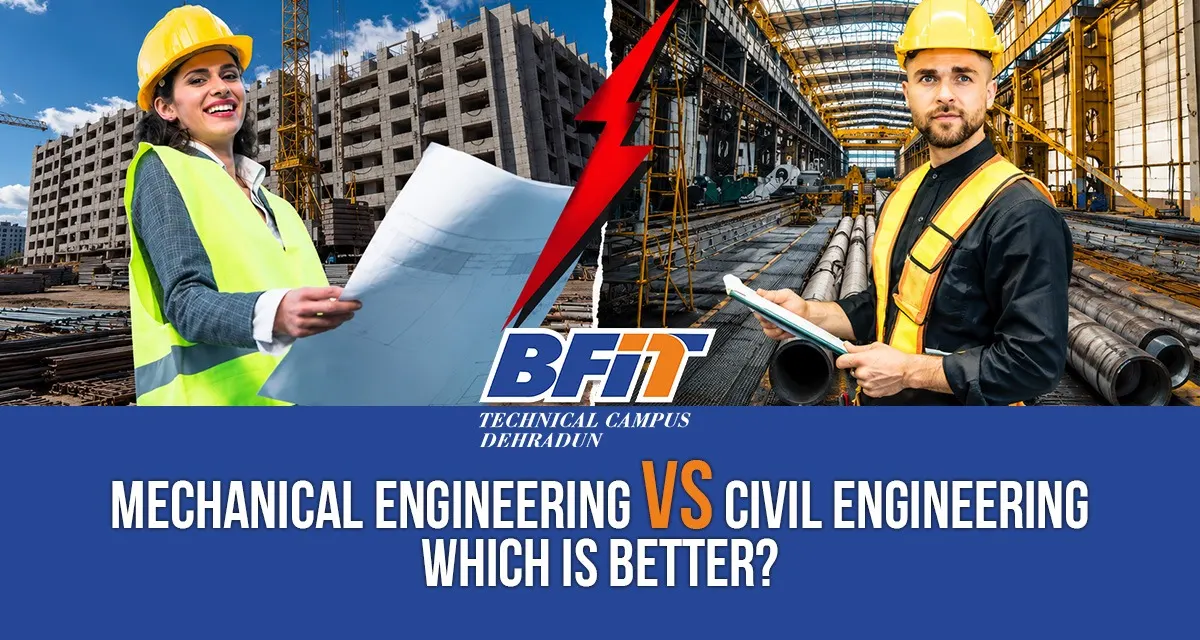
One of the most confusing career decisions a student has to make post Class 12 is between Mechanical Engineering and Civil Engineering. While both are a couple of the main branches of engineering, both are very old, both offer rewarding careers, the question boils down to which one is suitable for you.
However, if you are one of those students who do not get the idea and are not able to choose between the career of a Mechanical or Civil Engineer, then do not panic; these kinds of questions come almost a hundred or a thousand times every year. The correct and simple answer is that neither is better than the other. Both careers are equally good. Neither is greater than the other. That depends on your interests.
With mechanical engineers and the profession itself, it really does revolve around machines, movement, and energy. Now, how about those instances where you’ve been pondering the mechanics of the automobile engine or the cause of motion for the robot? Mechanical engineers have these answers.
In this area, you will be able to:
Mechanical engineers work in all kinds of branches of industry, starting with the automobile and aircraft industry to manufacturing and the energy sector, but if a machine or an object moves or utilizes energy, there’s surely a mechanical engineer’s work in it.
The work of a civil engineer is in engineering with structures and infrastructure, i.e., roads, bridges, buildings, dams, airports, and water supply systems. If you have ever been amazed at how high a building is or how long a bridge can span, realize that without a civil engineer, that bridge or building would not be there.
In this field, you:
Without a shadow of doubt, civil engineers are behind everything that surrounds us. Whether we take a ride on a highway or drink tap water, there is a civil engineer somewhere.
The basic differences between mechanical vs civil engineering careers:
| Area | Mechanical Engineering | Civil Engineering |
| Main Focus | Machines, motion, energy | Structures, buildings, infrastructure |
| Where You Work | Factories, labs, workshops, offices | Construction sites, project offices, outdoors |
| Key Subjects | Thermodynamics, fluid mechanics, robotics | Structural analysis, geotech, surveying |
| Industries | Auto, aerospace, manufacturing, energy | Construction, real estate, govt projects |
| Work Style | Mostly indoors, some field visits | Often, on-site, outdoor work is common |
| Creativity | Making things move efficiently | Making things stand safely |
Let’s address the important stuff – Mechanical Engineering Jobs vs Civil Engineering jobs. After all, it all leads to a job with your degree.
• Maintenance Engineer – Ensure factory machinery works.
Mechanical engineers are in demand. Work opportunities are plentiful. The booming electric vehicle sector is also an emerging field for mechanical engineers. Even the defense sector is on the verge of employing more mechanical engineers.
• Water Resource Engineer – designs dams and water systems.
And since India is coming up with new highways, smart cities, and metros in almost all cities, the need for civil engineers is equally high. Government jobs in PSUs such as NHAI, DDA, and irrigation departments attract quite a number of people.
Salaries in both fields are competitive. Entry-level mechanical and civil engineers typically earn between 3-6 lakhs per annum. With experience, compensation is influenced by individual skills, employer, and job role.
In the fields of oil & gas, aerospace, and automation, the mechanical engineer’s career path is quite bright. But as far as salaries go, civil engineers get better pay if they are appointed in a big state-owned construction company and on projects related to infrastructure development. Over a period of time, they receive roughly the same pay from both. But everything depends on the skills you possess for a particular task.
Mechanical vs Civil engineering career scope is vast for both streams.
Reasons for expanding the scope of civil engineering include-
BFIT Group of Institutions, Dehradun, offers two B.Tech streams: Mechanical Engineering and Civil Engineering. Here is why students have placed their trust in BFIT.
No matter whether mechanical or civil, BFIT will equip you to lead a career in engineering.
Mechanical engineering vs civil engineering – which is better?
Actually, the answer depends on you.
If you love machines, mechanics, and energy systems, then it must be mechanical engineering.
If you love building structures, construction, and massive infrastructure works, then it must be civil engineering.
Both fields are good for mechanical vs civil engineering. Both fields are good for salary and income. Both fields are respected very well. There is no mistake in choosing a field that is not of interest to you.
For a great start of your engineering path, the BFIT Group of Institutions is ready for it. BFIT Group of Institutions gives a proper engineering education through updated labs, expert teachers, practical exposure, and industry-oriented training to students of Mechanical or Civil Engineering.
We look forward to meet you here at BFIT. Our best college in Dehradun is an innovation ecosystem that develops students’ extraordinary creative vision and sharper critical thinking skills while also providing them with top-notch instruction. Come start a groundbreaking educational journey with us at BFIT Group Dehradun.

© 2026 BFIT . All rights reserved.
